
TWELVE-MONTH FACILITATOR TRAINING
Embodied Mahavidya Facilitator Training
Twelve Months with the Dasha Mahavidya — the Ten Wisdom Goddesses
This is classical Tantra, taught in the ways it was given to me.
The Dasha Mahavidya — the Ten Wisdom Goddesses — are among the most esoteric practices in the Tantric tradition. Ten forms of the Goddess covering the full range of what is alive: creation and destruction, desire and stillness, beauty and decay, speech, silence, power, dissolution. Not ten personalities to admire. Ten ways reality actually behaves, each with her own mantra*, yantra* and sadhana*.
Spend a year with them. Let them work on you. Learn to bring what they teach into the work you already do. Twelve months, one goddess at a time, with the tradition beside you and your own practice at the centre.
I first met these goddesses years before I was ready for them. The full transmission came later, within the Shivoham Tantra lineage.
The teachings belong to the tradition. The curriculum is mine — how these ten are sequenced, practised, and brought into contemporary work is a body of work I built and have taught for years.
This is the second cohort. The first one changed lives in ways I did not predict, and showed me what needed to be bigger.
* mantra — sacred sound · yantra — sacred geometry · sadhana — structured daily practice
What makes this unusual
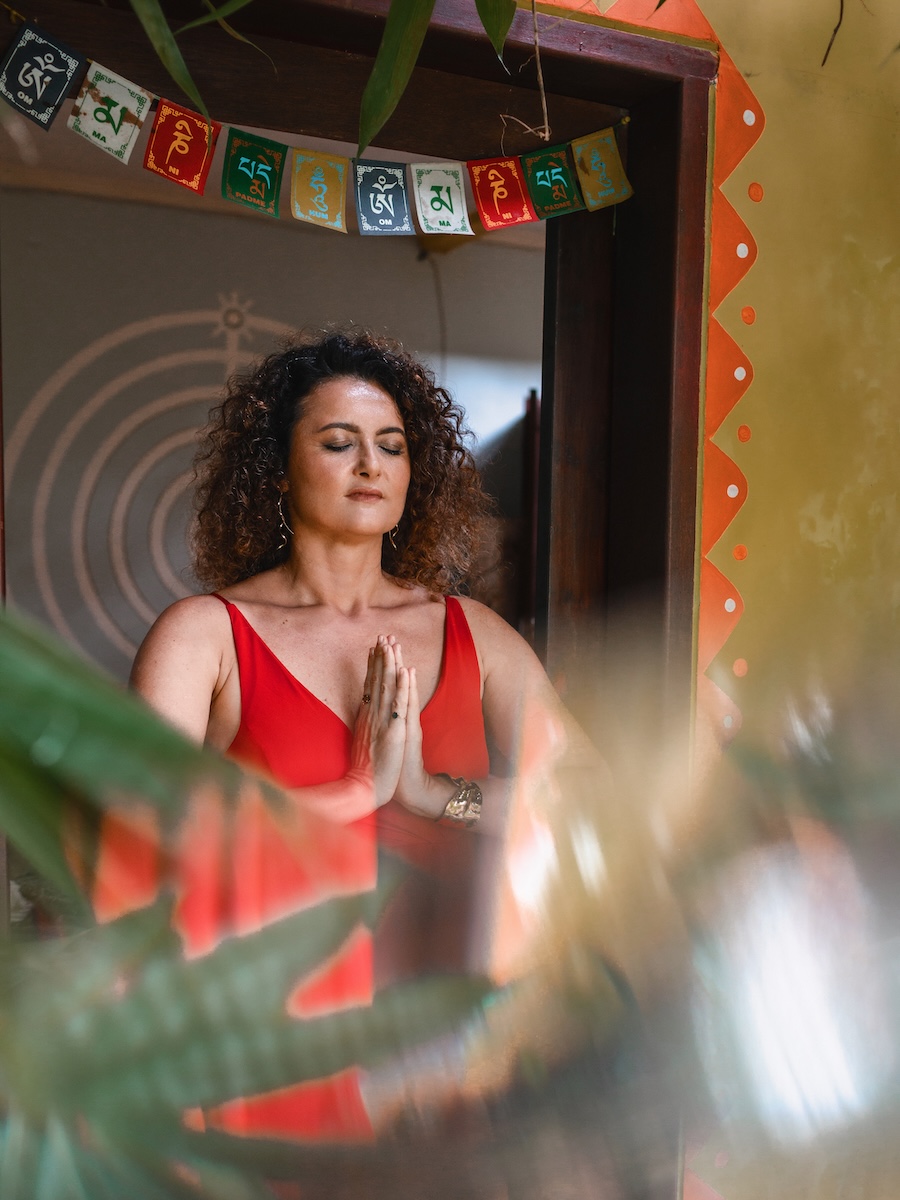
You are not being trained to become a Tantra teacher. That is not what this is, and I will not pretend otherwise.
You are being trained to do three things, in this order:
- Embody. Live with each goddess long enough that she stops being information. This is personal practice, month after month, and everything else rests on it.
- Integrate. Recognise where these principles are already operating — in your life, your relationships, and the work you do with people.
- Facilitate. Translate what you have understood into your own field. Coaching, therapy, yoga, retreats, education, art, ritual, whatever you already hold.
Your work will not look like mine. That is the point of the design.
I'm not teaching yoga or meditation or even tantra. It was really nice to see different ways the goddesses could be incorporated — in ways that are accessible to everyone.
Who this is for
Teachers, coaches, therapists, yoga teachers, bodyworkers, facilitators, artists, educators — people already working with others who want something more solid underneath what they offer.
Also people teaching nothing at all, who have been pulled toward these goddesses and want to go in properly, with structure and supervision rather than alone with a book.
Previous experience with the Mahavidyas is welcome and not required. What the year asks is a real practice, sustained month after month.
Women and men. The Dasha Mahavidya are not a women's subject.
What a month looks like
- 01One goddess. A module of teachings and practices, roughly 15–20 hours, worked through at your own pace — most people spend three to five hours a week.
- 02One mentoring session with me.
- 03One satsang with Guruma.
- 04A month of your own sadhana in between, with your cohort alongside you in The Current — the community where this training actually lives. (More on that below.)
- 05Then the next goddess.
Monthly mentoring with me
Once a month we meet live. These sessions rotate through three kinds of work:
- Questions and answers — whatever your practice has thrown up this month. The goddess you cannot get near, the one who arrived uninvited, the practical problems of sadhana in an ordinary life.
- Facilitation coaching — directed work on the skills: how to hold a group, how to introduce this material responsibly, ethics, discernment, presence, and the Goddess Method as a working tool.
- Practicum supervision — three of the twelve sessions are dedicated to supervised review of participants' projects.
This is the spine of the training.
With mentorship, there's a big difference between knowing something, saying something, and absolutely embodying the fact. I needed that little bit to embody it. And this just lit up my community — my students started to feel happy for who they are, looking for their pluses instead of trying to fix the minuses all the time.
The Dasha Mahavidya
Kali. Tara. Tripura Sundari. Bhuvaneshvari. Chinnamasta. Tripura Bhairavi. Dhumavati. Bagalamukhi. Matangi. Kamalatmika.
Ten faces of wisdom. Some tender, some frightening, none of them interested in your preferences. Each becomes a lens on your life for the month you spend with her — rarely the lens you expected.

Kali
Radical Truth
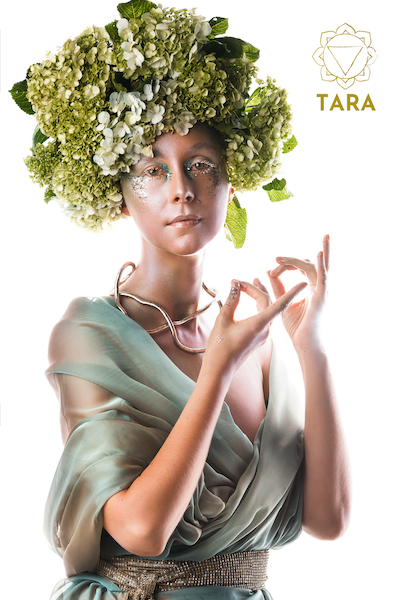
Tara
Compassionate Action
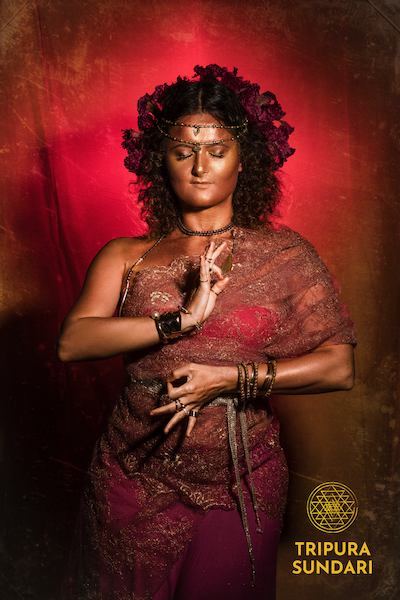
Tripura Sundari
Sacred Beauty

Bhuvaneshwari
Infinite Space

Bhairavi
Discipline & Power

Chinnamasta
Ego Surrender

Dhumavati
Wisdom Through Loss

Bagalamukhi
Stillness & Inner Authority

Matangi
Authentic Expression

Kamalatmika
Grace & Abundance
The satsangs
For this cohort I invited Guruma Dipti Tiwari Baswar of the Shivoham Tantra lineage to join us as Senior Lineage Faculty, and she said yes.
Guruma has spent her life inside a living Tantric lineage. Her own path is Ma Tara, and she practises within the lineage of Guruji Rajkumar Baswar. She carries the mythology, the symbolism, the philosophy and the traditional practice of these goddesses — from classical sources, from oral teaching, and from decades of her own sadhana. Much of what she teaches has never been translated into English.
Across twelve satsangs she opens the tradition itself. We begin with a foundational conversation — Ganesha, Shiva and Shakti, the ground you need before approaching a Mahavidya at all. Then one satsang for each goddess. Then a closing conversation, once you have walked the whole cycle.
These are conversations, not lectures. I interview and anchor, and my job is to keep the teaching within reach — to stop and ask what a name means, and to bring every teaching back to what it looks like in an ordinary life. You can send questions ahead and ask your own live.
Her perspective runs alongside the training rather than inside it. You meet these goddesses at more than one level, which is how the tradition itself holds them.
Your facilitation practicum
Across the year you build one original project: a workshop, a lecture, a guided meditation, a ritual, a coaching process, a therapeutic exercise, a retreat session, a card deck, a workbook, or something I have not thought of.
Every submission is supervised. You receive my supervision and, at minimum, review from one peer. A selection of projects is brought into the three mentoring sessions dedicated to supervision, for full peer and supervisor review in front of the cohort.
When the process opens you receive written instructions — what is expected, how it is assessed, how the supervision runs. The modules on the platform double as your reference for the kind of structure and depth being asked for.
What your project needs to show:
- integration of one or more Mahavidya principles
- originality rather than imitation
- practical value for the people it is for
- clear structure and facilitation
- ethical integrity
- enough depth to stand as a complete offering
What you need to complete
To receive the Embodied Mahavidya Facilitator Certification:
- Complete all ten Mahavidya modules
- Participate in the monthly mentoring across the year
- Submit your facilitation practicum and complete the supervision process
The Current
Your cohort lives inside The Current, my online community.
It is a working space, not a broadcast channel: a private thread where you share what the practice is doing, read what it is doing to everyone else, and take part in moderated processes and contemplations through the year. Kat Mereigh-Byrd, our Community Faculty, holds the space and draws the conversation out. Participate as much or as little as you want.
From the first year I started teaching the Mahavidyas, around a decade ago, the sharing between participants has been the most inspiring part of any training I have run. Different people meeting the same goddess in the same month, in lives that look nothing like each other — that is an experience no module can give you.
What builds over a year is a record of how these goddesses actually behave in people's lives. You will go back to it.
Who you will be working with
Dijan
creator and lead teacher
The curriculum, the Goddess Method, the mentoring, and the direction of the year.
Guruma Dipti Tiwari Baswar
Senior Lineage Faculty
Twelve satsangs on the traditional understanding of the Mahavidyas, from within a living lineage.
Kat Mereigh-Byrd
Community Faculty
Meditation teacher and Yoga Nidra specialist. Three years ago Kat turned her life toward slower, more meditative practice — practical meditation, connection to intuition, and Yoga Nidra as a way into deep insight and self-care.
She came to the Mahavidyas as a participant, looking for something that could hold a consistent meditation practice and connect her spiritual growth to her everyday life. Two years on: “They've become amazing mothers and aunties, helping me reparent myself.”
Now she holds the cohort space inside The Current. What she wants from the year: “that we, in this spiritual cohort, bring authentic conversations about the goddesses, their aspects, and how this work can change the world.”
Doing this together
Take the year with someone else, as Shiva and Shakti.
The clearest discovery of the first cohort was what happened between two people who did it together. They came out with a shared language for what was happening to each of them — a way of naming things in themselves and in each other that neither had before. The goddesses moved into the relationship. Nobody planned that, and it turned out to be one of the most valuable things the training produced.
The couples rate is not a second ticket at a discount. It is priced to make saying yes together the obvious choice.
Your partner, or a friend you want to practise with — couples do not have to be romantic partners.
What the first cohort said
“Each goddess has cracked me open in a different way — and never the way I expected.”
Gina's year included her father's heart attack, turning thirty-nine, and what she calls an ego death. She worked with Dhumavati through the collapse: “She helped me be in that in-between space, in the void. She gave me permission to let things die.” What died was “the part of me that doesn't trust, that wants to push, that wants to force, that feels like I have to prove myself. It's been an integral part of my personality my whole life.”
On why the structure held while her life did not:
It's grounded in so much tradition. It's not just, like, I channeled this goddess — which you see a lot of people do. It's really based on this long, long tradition. And there's a kind of safety in that. You can trust that you're being guided on a valid path, and guided very expertly.
The big aha moments I had in the past are not happening now — but I can see there is a subtle shift of energy, and I'm working in a different way with it. Using it when I need it.
If you ask me now how do I feel, I say I'm good — and it's not a lie.
Six months in, working with Bagalamukhi, she left the job she had been dreading. She now works in the direction her life had been pointing all along.
Beginning inside Navaratri
Navaratri — the nine nights of the Goddess — begins on 11 October 2026. There is no better time in the traditional calendar to start this work, and if you are enrolled by then, your year opens inside it.
You practise the Navaratri Sadhana with us, synced with the practice running at the ashram during those nine nights. Your first mentoring call is on 12 October, and your first satsang falls within Navaratri as well.
That is the practical difference between joining before the nine nights and joining after them. The teachings are the same. The opening is not.

Investment
Super Early Bird
until 10 October 2026
$1,555 solo
$2,111 per couple
Early Bird
during Navaratri, 11–19 October 2026
$1,777 solo
$2,333 per couple
Full
from 20 October 2026
$2,222 solo
$2,777 per couple
Super Early Bird and Early Bird also lock your place at the Bali immersion at $1,111 — the preferred EMF participant rate for July 2027, held for you until enrollment for the immersion opens.
Payment plans are available by enquiry, at a higher total than paying in full.
Enrollment closes 30 November 2026. If you join after 12 October, everything released up to that point is waiting for you and you begin with Kali.
Optional
The Bali immersion
11–25 July 2027 · Bali · 30 places
Fifteen days of classical Tantra, devotion, dance and ritual with our faculty, closing with a full-day Mahavidya Festival and Puja.
Not required for certification, and it never will be. What it adds: 100 hours of YACEP credit on top of your 200, supervised in-person practice, and the material in the flesh instead of through a screen. Separately priced, and open to people outside EMF as well.

Accreditation
Certification
Complete the curriculum, participate in the mentoring, and complete your practicum, and you receive the Embodied Mahavidya Facilitator Certification — accredited through YACEP (Yoga Alliance Continuing Education Provider) for 200 hours, with a further 100 for those who complete the Bali immersion.
It prepares you to bring the wisdom of the Mahavidyas into your own field responsibly and creatively. It does not confer traditional Tantric initiation, and it does not authorize you to teach classical Tantra. That authority belongs to lineage, and no training can hand it over.

About me
I have been on this path of study since 2009 and teaching since 2012, and the training never stopped. Seven years of full-time immersion with teachers across Southeast Asia and India built the foundation; annual retreats with my Tantra teacher, a three-year training in Somatic Experiencing and ongoing yoga therapy education carry it forward. I was trained in lineages, not just certifications.
Before this life I worked in the NGO world and as an EU expert and trainer, specialising in project management and intercultural learning. I loved every single thing I did in that eclectic background — until I didn't. Today I can see how all of it fits: every skill I built and every difficulty I met brought me to the synthesis I now teach.
I hold a lineage in classical Tantra and received the transmission of the Dasha Mahavidya within the Shivoham Tantra lineage. I co-founded one of Bali's most respected meditation centres. These goddesses have been the most esoteric part of my teaching, shared only with those genuinely drawn to this path — and this training is where all of it converges.
Next Steps
How to join
Enrollment is a single step. At checkout you give your name, your email, and a few sentences on what draws you to this training — then choose your payment option and you are in.
The rate applied is the one current on the day you enroll. Payment plans are arranged by enquiry.
After enrolling you receive access to the platform, your cohort space in The Current, and everything you need to begin on 12 October.
FREQUENTLY ASKED QUESTIONS
What are the Dasha Mahavidya?
Do I have to practise all ten goddesses?
You will study and practise with all ten across the year — that is what a twelve-month training is for. What you are not being asked to do is carry ten sadhanas for the rest of your life.
What the year teaches you is how to recognise them: to see which one is operating in a situation, in a relationship, in your own state on a given morning, and to know which door to enter through. Ten archetypes can feel overwhelming at the start. Once they are in you, working with them becomes something closer to fun — you stop managing ten practices and start reading your life through them.
Is this a Tantra teacher training?
What is a Mahavidya sadhana?
Do I need initiation to practise the Mahavidyas?
How much time does this take?
Is the training live or self-paced?
Can I join after the training has started?
Do I need previous experience, or to be a facilitator already?
What language is the training in?
What is the refund policy?
Begin
The year opens inside Navaratri, on 12 October 2026.
Enrollment closes 30 November.
Stay connected
Join the mailing list for insights, updates, and early access to new work.
Work that helps you move out of over-functioning and into a more grounded, clear, and embodied way of living.
ContactDijan is a brand operated by Inner Contemplation LLC, a limited liability company registered in Wyoming, USA.